
While admitting India's persistent stand on the issue might delay the agreement, a top commerce ministry official said the talks were on track. "We will maintain a hardline stand," said the official. It is to be noted, the sixth round of EU-India trade negotiation in Delhi in March ended without any substantial progress because of the tariff-related issues. The EU is India's largest trading partner and the total bilateral trade stood at over $70 billion in 2008-09.

'The government is actively engaging with EU to ensure that concerns of Indian companies and hard-to-abate sectors are adequately addressed under CBAM'

With an ambitious target to more than double their bilateral trade to $200 billion in the next four years, India and EU hoped on Friday they can resolve differences and reach a free trade agreement within a year.
'In the Indian government there are no illusions about the United States reliability or the possibility of having any kind of preferential treatment from Washington when it comes to trade.'
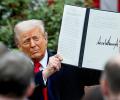
'April 9 announcement of slapping a 125% tariff on Chinese goods has brought the focus back to China, making this new phase feel like a repeat of the original conflict.'

The agreement provides for extensive cooperation in the civil nuclear energy sector including in research and development for peaceful uses of nuclear energy, they said.

Analysts believe Tesla will first focus on building the Model Y brand before expanding -- both in terms of volume and models.

Officials from India and the United Kingdom (UK) are working overtime to address the contentious issues related to the proposed free trade agreement (FTA) between the two nations, in a final push to conclude the deal by the year-end. Commerce secretary Sunil Barthwal was headed to London on Thursday after completing his four-day visit to Brazil. Other key officials from India's negotiating team will be joining Barthwal in the UK capital, hoping to make headway in the FTA negotiations, which started in January last year, a person aware of the matter told Business Standard.
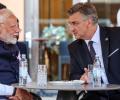
In his media statement following talks with his Croatian counterpart Andrej Plenkovic, Modi said both leaders agree that "terrorism is an enemy of humanity" and is inimical to forces that believe in democracy.
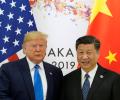
'If you compare the data from 2017 and 2023 of the US imports from the world and China, you will see that the US was a complete loser in the trade war, and China was a complete gainer.'

Talks for an India-European Union free trade agreement started in 2007 and the eighth round of negotiations was completed in New Delhi last month.
The European Union may back off from its insistence on including non-trade issues like human rights in the proposed free trade pact with India.
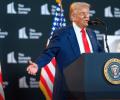
On August 7, the US president announced doubling tariffs on Indian goods to 50 percent for India's purchases of Russian crude oil, but gave a 21-day window to negotiate an agreement.
European Union is not contemplating signing free trade agreement with India in the near future and will focus on completion of contentious World Trade Organisation negotiations including agriculture and Singapore issues

Under the FTA in the Services sector, India wants the EU to ensure free mobility of professionals without restrictions such as experience whereas the EU wants greater commitment by India to allow foreign investment in services such as retail, legal and postal.

Snapping the two months slide, the country's merchandise exports rose marginally by 0.5 per cent to $34.58 billion in September while trade deficit narrowed to $20.78 billion. According to official data released on Wednesday, imports increased by 1.6 per cent to $55.36 billion in September compared to $54.49 billion in the year-ago period. The trade deficit, or the gap between imports and exports, was $20.8 billion during the same month last year.

India's new climate pledge to the UN could be weakened by its growing use of coal, even as the country plans a 2035 roadmap to cut emissions and boost clean energy.
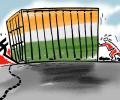
The USA's steep 50 per cent tariffs on Indian goods entering America will severely impact exports and job creation in labour-intensive export sectors such as shrimp, apparel, leather and gems and jewellery. Exporters said that the imposition of a 25 per cent penalty on India over and above the 25 per cent tariffs move will disrupt the flow of Indian goods to its largest export market.

During the talks, both sides failed to reach on a conclusion and has agreed to meet again in June.

With the pressure on for the European Union (EU) and India to come up with a significant announcement at the upcoming EU-India summit on December 10, a flurry of activity surrounding the ongoing negotiations for a bilateral free trade agreement (FTA) is giving momentum to the process.
The talks are being held in Brussels between high-level delegations from India and EU, led by Commerce Secretary G K Pillai and Director General of European Commission Davis O'Sullivan.

India and the 27-nation European Union are negotiating Broad based Trade and Investment Agreement since June 2007, but a breakthrough has not yet been achieved due to strong differences on several of the issues.

In a move that could improve the weakening sentiment in the Indian textile industry, the government is set to sign a free trade agreement (FTA) with the European Union (EU) by the end of the current calendar year.
According to Indian officials, both the sides have had "fruitful consultations" regarding elimination of tariffs on 90-95 per cent of goods, but the EU's insistence on including non-trade issues, such as child labour, labour laws and climate change, in the trade pact are coming in the way of concluding an agreement.
India and Germany on Thursday began their 2nd round of Inter-Governmental Consultations during which crucial bilateral, international and regional issues like the long pending India-EU Free Trade Agreement and the situation in Afghanistan would be discussed.

India's policy for agriculture trade must move commodity-by-commodity to gain maximum benefits as US President Donald Trump's 26 per cent tariff on exports from the country take effect, said agriculture economist Ashok Gulati in a recent policy paper.
Industry body Assocham on Monday said country's top CEOs are in favour of signing a specialised free trade agreement with the European Union in services.

Despite all official assurances, the path towards a free trade agreement (FTA) between India and the European Union (EU) this year remains ambiguous, as both sides are unwilling to relax their stand on the biggest stumbling block - the issue of "data exclusivity".

The proposed India-Israel trade pact should be beneficial to both nations and until New Delhi gets a good deal, it would not do an agreement, Commerce and Industry Minister Piyush Goyal said. India and Israel are negotiating a free trade agreement (FTA) since May 2010. "With Israel, until we get a good deal, we will not do an FTA. It has to be reciprocally beneficial," the minister said in San Francisco on Tuesday while interacting with the Indian community.
The EU should eliminate tariffs on 95 per cent of the goods under the Free Trade Agreement instead of the 90 per cent being targeted by the India-EU High Level Trade Group, the industry body said.
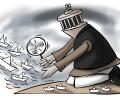
As India goes into firming up trade deals with developed nations like Australia, the United Kingdom (UK) and the regional bloc, and the European Union (EU), it will have to be well prepared to negotiate on new-generation issues, such as data protection regulation, e-commerce, and environment. India is yet to negotiate pacts with its trading partners on these evolving issues since discussions between them have until now been largely focused on tariff and non-tariff barriers and the rules of origin. "We can no longer look at trade just as trade. We have to look at it in totality of global and regional conditions.
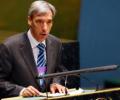
India was apprehensive because EU was pushing for data exclusivity provisions that would have affected domestic pharma companies.

The proposed India-European Union free trade agreement (FTA), which seeks to liberalise trade in goods and services, could be materialised by this year, EU Ambassador to India Joao Cravinho has said.
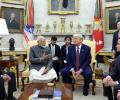
'No retaliatory tariffs now. You can retaliate after a few months.' 'Today, there is no need to retaliate because it is a question of long term benefits.'

Why should India buy olives from Europe when it could do so from the world's largest producers?
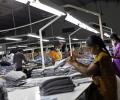
In the shadows of a sliding rupee, India's knitwear hub Tiruppur is weaving a success story. While the domestic currency edges closer to the 86 mark against the US dollar, triggering concerns for many sectors, this textile town in Tamil Nadu is finding opportunity in adversity: Between April and December alone, Tiruppur's exports reached Rs 26,000 crore, almost eclipsing last financial year's total of Rs 30,690 crore.

'...the auto industry to get back to 7% to 8% annual growth.' 'High growth in the SUV segment alone will not achieve this, as it is a small market.'
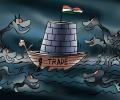
Countries negotiating free trade agreements (FTAs) need to keep in mind eight "myths" which surround these pacts, like they lead to accelerated increase in exports and promote domestic manufacturing, according to a report by think-tank GTRI. The report by Global Trade Research Initiative (GTRI) claims to dispel these 'myths', including that FTAs weaken the WTO (World Trade Organisation), countries are rushing to do FTAs, and these pacts promote investment and lower prices. It is "erroneously" believed that most world trade happens through the FTA route, but in reality, it is less than 20 per cent, said the report titled 'FTAs: Fabulous, Futile, or Flawed?'.
 © 2026 Rediff.com - Investor Information - Advertise with us - Disclaimer - Privacy Policy - Sitemap - Feedback - About us - Terms of use - Grievances